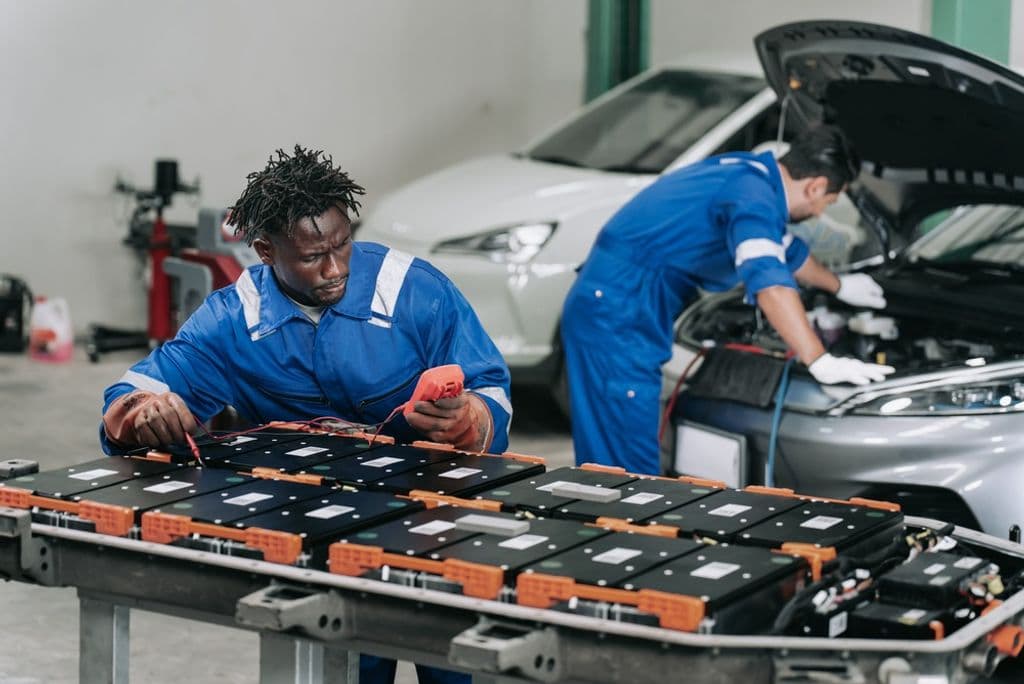
Electric vehicle batteries are among the most important components in the development of electric mobility, as they determine driving range, performance, charging time, and vehicle efficiency.
As technology continues to advance, batteries are becoming lighter, offering greater capacity, charging faster, operating more safely, and becoming increasingly environmentally friendly.
These developments have made battery technology a key area of interest not only for vehicle manufacturers but also for governments and industries across Asia, including Indonesia.
So, what are the different types and components of electric vehicle batteries, how should they be maintained, and what does the future hold for battery technology and its ecosystem?
Types and Technologies of Electric Vehicle Batteries
Different electric vehicles may use different battery technologies. The type of battery affects energy capacity, weight, cost, lifespan, and driving range.
1. Lithium-Ion (Li-ion)
Lithium-ion is the most widely used battery technology in electric vehicles. These batteries offer high energy density, relatively low weight, a long lifespan, and relatively fast charging capabilities.
One of its variants is lithium-ion NMC (Nickel Manganese Cobalt), which offers high capacity and energy density. In addition to NMC, there is LFP (Lithium Iron Phosphate), which is known for its thermal stability and durability.
2. Nickel-Metal Hydride (NiMH)
NiMH batteries are commonly found in hybrid vehicles. Compared with lithium-ion batteries, they have lower energy density, resulting in a more limited electric driving range.
However, this technology offers good durability and is relatively resistant to overcharging.
3. Lead-Acid
Lead-acid batteries are a long-established battery technology. They are relatively inexpensive and easy to recycle.
However, they are heavy and have relatively low energy capacity and efficiency.
4. Nickel-Cadmium
Nickel-cadmium batteries offer good resistance to repeated charging cycles and extreme temperatures.
Their disadvantages include heavy weight, relatively low capacity, and the presence of toxic cadmium, which has increasingly limited their use in modern vehicles.
5. Solid-State Batteries
Solid-state batteries are among the battery technologies currently receiving significant research and development attention.
Instead of using a liquid electrolyte, as conventional lithium-ion batteries do, this technology uses a solid electrolyte.
Solid-state batteries have the potential to offer higher energy density, lighter weight, improved safety, and longer driving ranges.
However, production costs and challenges associated with large-scale manufacturing remain significant obstacles.
Read Also: Electric Cars During Floods: A Safety Guide for the Rainy Season
Main Components of Electric Vehicle Batteries
In addition to understanding the different battery types, knowing their main components helps explain how energy is stored and used in electric vehicles.
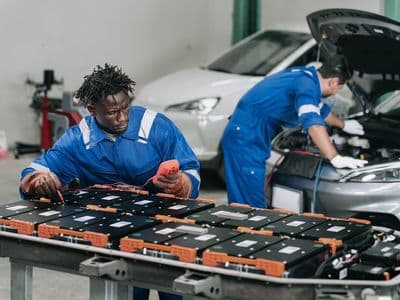
In general, a battery consists of an anode, cathode, electrolyte, separator, and current collectors.
The anode and cathode are where electrochemical reactions occur, while the electrolyte facilitates the movement of ions between them.
Electric vehicle batteries are also equipped with a Battery Management System (BMS).
This system monitors battery conditions, including voltage, temperature, current, and state of charge, while helping ensure that the battery operates within safe limits.
Electric Vehicle Battery Lifespan and Maintenance
High-voltage lithium-ion batteries used in electric vehicles are generally designed to last around 8–15 years, depending on the technology, usage patterns, environmental conditions, and battery management system.
Many manufacturers also provide battery warranties of approximately eight years or up to 160,000 kilometers.
Unlike the main traction battery, the 12-volt battery also used in electric and hybrid vehicles generally has a lifespan of around three to five years.
How to Maintain Electric Vehicle Batteries
Several simple practices can help maintain battery condition, including:
- Use a charger that meets the vehicle manufacturer's specifications.
- Avoid frequently allowing the battery to become completely discharged.
- Avoid leaving the battery fully charged for extended periods.
- Minimize exposure to extreme temperatures and excessive heat.
- Follow the manufacturer's recommendations regarding charging limits and vehicle operation.
Battery maintenance is particularly important in tropical countries such as Indonesia, where high ambient temperatures can affect battery performance and thermal management.
The Electric Vehicle Battery Ecosystem in Asia and Indonesia
The development of electric vehicles is closely linked to the expansion of the electric vehicle battery ecosystem.
This ecosystem covers raw material mining and processing, battery production, vehicle manufacturing, charging and battery swapping stations, and recycling.
Asia holds a strategic position as a major hub for vehicle and battery manufacturing.
Indonesia has substantial nickel reserves, creating opportunities for the country to play an important role in the electric vehicle battery supply chain.
The Indonesian government has also promoted the acceleration of electric vehicle adoption through Presidential Regulation No. 55 of 2019, with the aim of reducing dependence on petroleum-based fuels, lowering emissions, and creating added value for domestic industries.
At the ASEAN level, each country has different strengths. Regional collaboration can help establish a stronger electric vehicle supply chain across Southeast Asia.
Indonesia has mineral resources, Malaysia and the Philippines have capabilities in the semiconductor industry, while Thailand and Vietnam are developing as vehicle manufacturing hubs.
Future Developments in Battery Technology
Battery innovation is no longer focused solely on lithium-ion technology.
Sodium-ion batteries are being developed as an alternative that could reduce dependence on lithium. This technology also has potential for applications under certain environmental conditions, including cold climates.
Lithium-sulfur technology also holds promise for achieving higher energy density while reducing dependence on certain critical minerals.
Meanwhile, solid-state technology continues to be developed to enable electric vehicles to achieve longer driving ranges and improved safety.
Other developments include fast charging, structural batteries integrated into vehicle designs, wireless charging, and vehicle-to-grid (V2G) technology.
With V2G, electric vehicles may eventually be able not only to draw electricity from the grid but also to supply electricity back to it when needed.
Battery Recycling and Second-Life Applications
The future of battery technology also involves what happens after batteries are no longer suitable for vehicle use.
Recycling technologies continue to be developed to recover valuable materials such as lithium, nickel, cobalt, and graphite.
Used electric vehicle batteries can also be repurposed for less demanding applications, such as stationary energy storage.
This approach supports the circular economy while reducing the need for newly extracted raw materials.
Read Also: Second-Life Batteries: The Potential of Used EV Batteries for Energy Storage
Leading the Development of Indonesia's Electric Vehicle Ecosystem with TBS
One of the companies contributing to the development of Indonesia's electric mobility ecosystem is TBS.
In 2021, TBS and GoTo Group established PT Energi Kreasi Bersama (Electrum) to develop an integrated electric mobility ecosystem covering vehicle assembly, battery technology, battery swapping infrastructure, charging stations, and financing.
In February 2022, President Joko Widodo inaugurated the launch of a collaborative electric vehicle ecosystem involving Electrum, Pertamina, Gogoro, and Gesits.
In the same year, Electrum also participated in the G20 and B20 Summits in Bali by providing 50 electric motorcycles, 11 shelters, and 150 Gojek driver partners.
In December 2024, Electrum secured US$15 million in financing from the Asian Development Bank, the Australian Climate Finance Partnership, and Bank DBS Indonesia.
The financing supports vehicle procurement and the expansion of its battery swapping network, which is projected to reduce greenhouse gas emissions by up to 123,000 tonnes per year.
Electrum subsequently launched the H3i at IMOS in October 2024, offering both home charging and battery swapping options. In 2025, the company introduced the H1 as a new option for consumers.
By 2025, Electrum had supported more than 15,000 electric vehicles across Jakarta and surrounding areas through over 500 Battery Swapping Stations, recording more than 19,000 battery swaps per day.
The ecosystem has also contributed to avoiding more than 3,200 tonnes of CO₂ emissions.
These achievements by TBS demonstrate how the development of an electric vehicle battery ecosystem can play an important role in Indonesia's transition toward cleaner and more sustainable mobility.