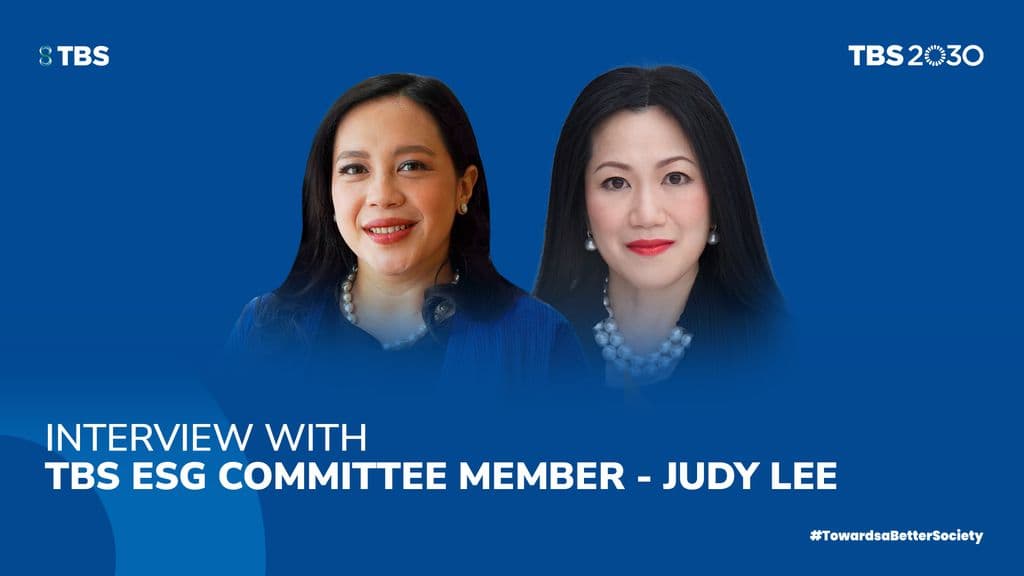
As sustainability and socio-economic issues continue to receive unwavering attention, Environmental, Social, and Governance (ESG) has become a key principle that corporations implemented to ensure a positive impact on the environment and in society. With the recent plan to grow in low-carbon sectors, TBS is determined to integrate ESG values in its growth strategy, such that it results positively across the triple bottom line of People, Planet, and Profit.
After previously launching a series of 2030 commitments titled Towards a Better Society 2030 (TBS2030), TBS marked its leadership in Governance by forming an independent ESG Committee that supports TBS Board of Commissioners in reviewing the practice and performance of TBS primarily with respect to ESG, as well as overseeing the implementation, progress and initiatives formed in relation to the TBS2030 agenda. Taking part in TBS ESG Independent Committee is Judy Lee (JL), a New York-based risk management expert with over 30 years of experience, who was previously EVP of Solar Frontier, an integrated solar energy subsidiary of Showa Shell Sekiyu, then part of the Royal Dutch Shell Group. Judy was also appointed to the Board of Directors of DBS Group Holdings Ltd and DBS Bank Ltd., where she serves as a member of each of the Audit Committee, the Board Risk Management Committee, the Compensation and Management Development Committee and the Board Sustainability Committee. She also Chairs the Board Sustainability Committee for SMRT Corporation.
TBS’ SVP Sustainability, Triana Krisandini (TK), recently sat down with Judy to discuss her role as an independent representative of the ESG Committee and the importance of putting sustainability at the center of TBS’ business growth.
TK: What role does the ESG Committee have?
JL: ESG is integral to TBS’ transformation, so the creation of an ESG Committee at the BOC shows significant commitment from the leadership team. As the ESG committee, our role is to ensure that the ESG goals and strategies laid out by management is aligned with the direction and pace of our transformation. We will also advise and provide feedback on how to make the strategy and roadmap more robust and track the progress and execution. So similar to the other board committees, we will focus on governance but there is an additional and critical role to encourage and provide guidance on how we should best execute the strategies. I think it's an important balance of pushing ahead with a very strong ESG agenda, but at the same time being practical, actionable and also measurable.
TK: What are your duties and responsibility as an ESG Committee?
JL: It's an inward and outward role. Internally, we actively support and work with the team throughout the TBS organisation to validate the strategies and ensure that both the roadmap and milestones are in place. Meanwhile, the outward role is equally important. ESG is such a fast-changing area. It’s important to provide an external perspective from other markets and from my experience across different industries. There are many great lessons that we see in different approaches globally, and we want to learn and apply them at TBS, to be best-in-class in everything we do.
TK: What do you hope to achieve in this role?
JL: With the current strategic roadmap, TBS is poised to make a huge transition and meaningful impact within a short time. Hence, we need to actively navigate towards that direction by safeguarding our own objectives. Part of it is by making the right decisions, timely trade-offs, and putting in the capital and resources necessary to achieve our goals. The other aspect I can help with is to support TBS to become an example for other companies who are struggling with making a just transition, not only in Indonesia but also in other markets. TBS is a leading energy player to transition away from carbon-based businesses. I would love for TBS to be a template for others to follow. And at the appropriate time to communicate about its journey and lessons learned so that others can be inspired to commit to a similar transition that would make the entire company an example of additionality.
TK: How would you define a successful ESG practice for TBS?
JL: In terms of this ESG independent advisory role, we get a chance to call things out. We get a chance to look objectively and outside to give TBS a new perspective. So that's one aspect of it. Generally, I think there are two questions we need to pay attention to: “Are we charting our course?” and “Are we able to realise our own objectives and goals?” From those two questions there are several other points we measure, from “how does the management’s decision fit into the roadmap?” to “can we achieve all that?” Because even if we understand how this could be done in another company in the same industry, we have to make sure that we're true to what we need to do here in our own transition.
TK: What are worldwide trends that you're seeing now on ESG?
JL: Overall, the discussion has gotten deeper. Companies are looking at their ESG metrics and making commitments with timelines. We see more companies moving towards science-based targets and measuring double materiality. We also know that there is increasing convergence around standards and regulatory reporting. The trend across all markets is that listed companies are required to report ESG targets, strategies and metrics as a part of their disclosure. After COVID, I think many companies have started to think about what is required differently, which led to more consciousness of the impact they’re making on the community and society, and particularly on their employees. Now companies have no choice but to be open to explore what the work-life and workforce is going to be like in the future. I think that is a huge trend we need to be on top of and we need to focus more on the “S” part of ESG.
TK: As a part of the ESG Committee how do you envision working with TBS, especially with the related departments?
JL: When I got to know TBS, I was really impressed with how the board members and management are committed to this journey of transition. I really liked the fact that the team is proactive and instrumental in leading the whole process of what needs to be put in place organizationally. TBS really focuses on the internal stakeholder approach and developed the framework in a practical and meaningful way to engage every business. It is codified in a program that includes targets and policies, reevaluating the businesses from a ESG lens and executing a transition plan with clear metrics. Everything is done transparently with emphasis on engagement and communication, so it's clear that people understand and participate in the journey.
TK: What are we supposed to do day-to-day to support TBS’ ESG commitment?
JL: The simplest way is to make sure that we don't have a rigid mindset or unconscious bias. This applies to how we transform into greener businesses as well as how we embrace diversity. We all have some biases because of our experiences, so we have to work on being more self-aware. With regard to diversity, the company can look at data to check that there aren’t inherent biases that are part of the structure. Then it's a mindset shift. For example, gender diversity has been so far behind in every industry that I've been in. Therefore, we need to actively plan “how many women we need to bring in the pipeline?” so that from a very practical standpoint we prepare “what we need to do” -- we make the shift, we train them, get them comfortable in nontraditional roles, and get the men around them comfortable. As a company this is what we stand for, then we commit to drive the processes, as uncomfortable as it may be at times to get the job done. So, to support TBS’ ESG commitment we must be comfortable with change.