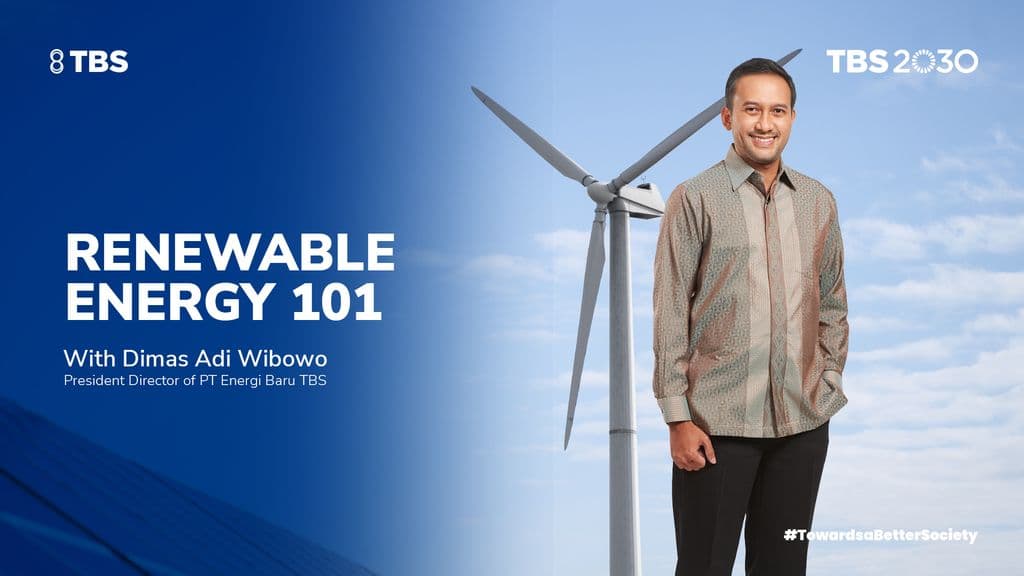
The term “renewable energy” can be spotted everywhere these days, but what exactly does it mean? To answer this question, we sat down with the Director of PT. Energi Baru TBS, Mr. Dimas Adi Wibowo who gave us a thorough introduction to renewable energy that we will discuss further.
The 21 st century has seen a major setback in climate and environmental conditions. We are now facing an alarming situation that threatens the future of humans and the whole ecosystem. As we attempt to tackle this issue together, a solution has been considered as one of the keys to solve the problem, and that is renewable energy.
In its simplest meaning, renewable energy can be defined as energy that is derived from natural and sustainable sources. These sources are materials around us that will never cease. Some of the most common are wind, sunlight, geothermal, water, heat, and even biomass. It is the complete opposite from fossil fuels, which came from the buried remains of prehistoric animals and plants that died million years ago. We have been taking advantage of fossil fuels as our main source of energy for almost the past two centuries. Thus as they start to decrease, the switch to renewable energy becomes non-negotiable.
But decreasing fossil fuel resources is not the only reason behind the urgency of swapping fossil fuels for renewable energy, as it also has many long-term benefits for the earth’s future. As the Director of PT. Energi Baru TBS, Dimas has seen three main advantages of renewable energy usage, so let’s break them down one by one. First and foremost, it reduces greenhouse effect and pollution. Fossil fuels generally consist of carbon, and when they are burned they increase carbon dioxide in the earth’s atmosphere, hence the usage of fossil fuels like oil or coal contributes to greenhouse effect and pollution. On the other hand, renewable energy releases little to no gasses or pollutants, making them a better energy solution for the earth’s atmosphere.
The second benefit lies in energy diversification. As an archipelago, Indonesia is put in an advantageous position when it comes to energy diversification. We have a vast amount of natural riches that have potential to be used as a source for renewable energy. Each geographic area can utilize different energy, and the utilization of the area’s energy source can further enhance economic development.
Lastly, Dimas mentioned one great impact for the social and economic sector which is the emergence of new industries and technological advancement. Still related to the previous point, the establishment of renewable energy in every part of Indonesia will also bring new technologies and industry to many areas. Thus, new opportunities will open for people in these areas and they will receive continuous transfer of knowledge beneficial in the long run.
After seeing all these benefits you might be wondering, why haven’t we fully switched to renewable energy? That is because its implementation comes with big challenges. They are mainly in:
- Security of Supply: each renewable energy source creates different levels of energy, and making sure the energy can sustain is a challenge.
- Affordability: most renewable energy power plants are located in remote areas, making their establishment expensive because supporting facilities also have to be built in order to create a whole working system.
- Environmental: location-wise, renewable energy power plants are built in areas that might border or intersect with forests, so getting permits is a challenging task.
Despite the many challenges, Indonesia has a lot of potential to unleash when it comes to renewable energy. Creating the change will be a long process, but right now our generation holds the key to secure a better future for our children. As Dimas sternlystated in his final message, “each step we take towards a shift to renewable energy will create a safer future."