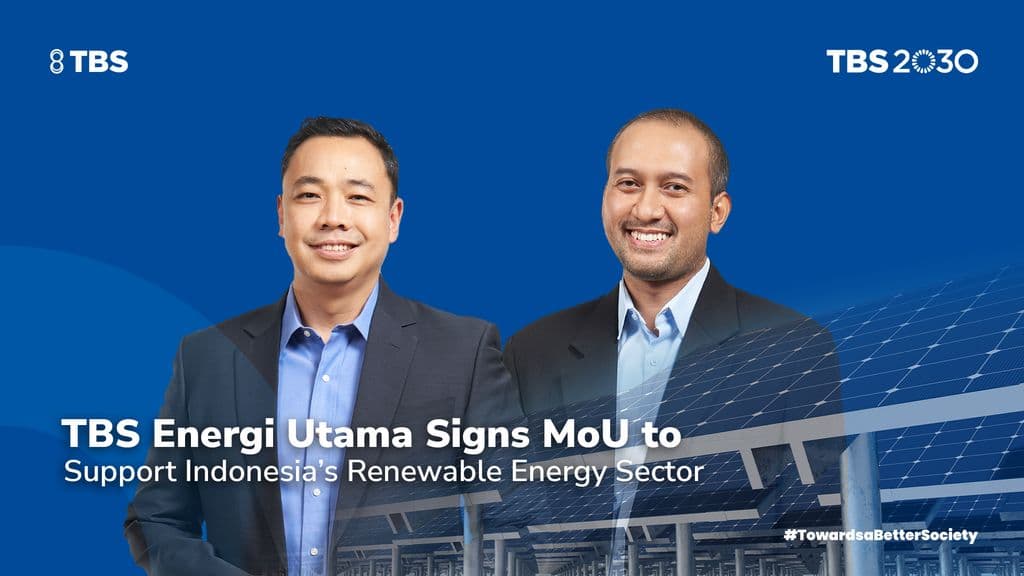
Taking one more step forward to bring our renewable energy commitments to reality, TBS Energi Utama through Energi Baru TBS (EBT) signed a Memorandum of Understanding (MoU) on 16 March 2023 in Singapore. Signed together with PT Adaro Clean Energy Indonesia and PT Medco Power Indonesia, the MoU was made as a statement by the three private energy companies to support the development of Indonesia’s renewable energy sector and the industrialization opportunities of the solar PV/BESS supply chain. We engaged in a discussion with the Director of Energi Baru TBS, Dimas Adi Wibowo and the Commissioner of Energi Baru TBS, Arthur Simatupang to gain insights on the MOU.
Before jumping into the MoU between the three energy companies, it is important to note that prior to the signing, the governments of Indonesia and Singapore had also signed another MoU. The government-to-government MoU is aimed to develop opportunities for cross-border electricity supply, an act that will advance both countries’ long-standing cooperation in renewable energy. The MoU is in line with Singapore's goal to fully shift its power supply in ten years and this goal is seen as an opportunity to support Indonesia’s intention to downstream industries. “This (downstream) will generate many long-term and strategic multiplier effects for the country including job creation and transfer of knowledge,” states Arthur, explaining the potential benefits of the collaboration.
Singapore’s investment in Indonesia will be focused to develop one technology, Photovoltaics (PV) or more commonly known as solar panels. This includes everything that comes along with it, from panels to battery storage, which Indonesia still imports from abroad. Until now, domestic fulfilment needs for good quality PV Module Tier-1 products are still limited, so it is necessary to strengthen local supply that is economical and good quality. In return, Indonesia will export electricity to Singapore, which Arthur mentioned will possibly be from nearby areas such as Kepulauan Riau.
While there are many resource options for renewable energy, the decision to develop solar energy is backed by underlying conditions in Indonesia, such as population density and solar radiation. “Taking scalability, affordability, and licensing into consideration, we found that solar is most feasible, given the project’s relatively short timeline,” Dimas states.
As an energy company, TBS perceive the project as an opportunity to attract more PV manufacturers to Indonesia. According to Dimas, there is currently still a mismatch between supply and demand in Indonesia, which is why the three MoU signees (TBS, Adaro, and Medco) are taking part in assisting Indonesia's effort to downstream the industry.
In the long run, an established and downstream renewable energy industry will also facilitate their future projects.This strategic step with Singapore is expected to be the first step to encourage industrial capabilities in Indonesia which will become the mainstay of supply needs in the future to meet local demand for PV development in Indonesia. Hence, once the project finishes and the focus shifts away from exports, local developers will have sufficient tools and skilled workers to build Indonesia’s solar energy industry for usage within the country.
By taking part in supply chain and downstream activities, Energi Baru TBS will also gain firsthand access to equipment from tier 1 producers and outward information regarding global market conditions, both highly valuable for TBS’ future growth plans. A piece of good news for TBS which is working towards a transition to green and renewable energy.
“The MoU is a golden opportunity for TBS to keep evolving,” Arthur exclaims, expressing his enthusiasm for TBS being part of the project. The MoU is a glimpse of Energi Baru TBS’ future growth and the beginning of TBS’ active involvement in Indonesia’s renewable energy journey.