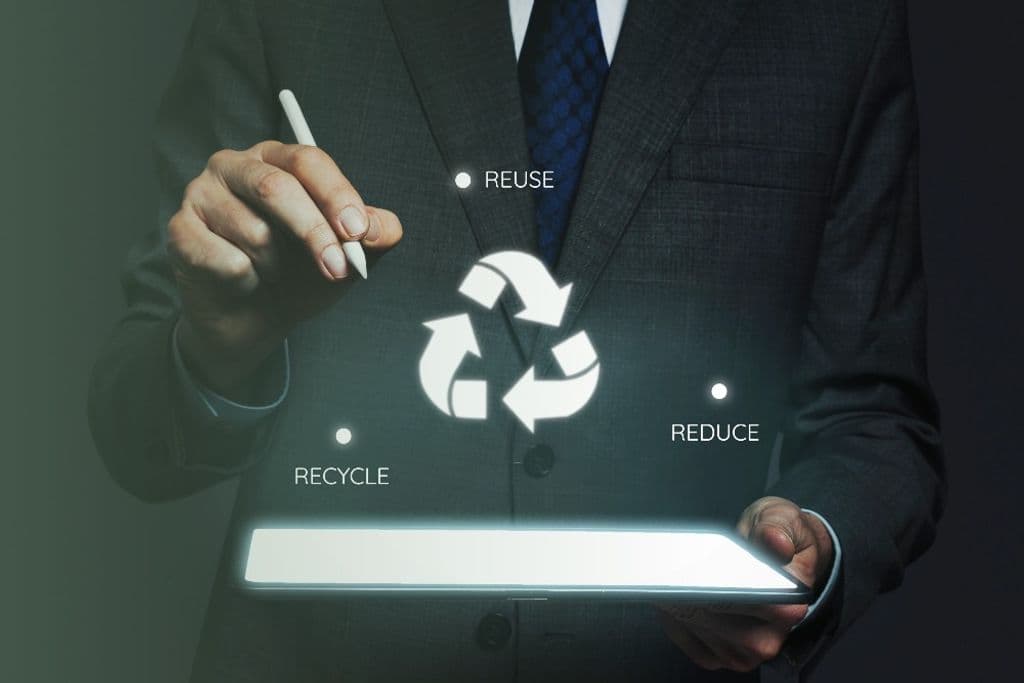
The reuse symbol is a new symbol designed to help people distinguish reusable packaging from single-use packaging.
Its introduction is not simply about adding another logo to packaging. It is part of a global effort to reduce waste, lower carbon emissions, and build a more sustainable reuse system.
For decades, people have been familiar with the recycling symbol. However, as the concept of the circular economy continues to develop, experts have concluded that recycling alone is not enough to address the waste crisis.
This is why the reuse symbol was created as a new guide to help people participate more effectively in reuse systems.
The concept is also becoming increasingly relevant for Indonesia as the country continues to face growing waste management challenges each year.
What Is the Reuse Symbol?
The reuse symbol is a logo featuring the letter R formed by circular arrows. It was introduced by PR3 together with an international community of designers, reuse system operators, governments, and sustainability experts.
Unlike the recycling symbol, which indicates that a material can be processed into a new product, the reuse symbol shows that the packaging has been specifically designed to be used repeatedly within a reuse system.
This means that after use, the packaging is not immediately discarded or recycled. Instead, it is collected, cleaned, and circulated again for use by other consumers.
Within this system, a single package can be used dozens of times before eventually entering the recycling process when it reaches the end of its useful life.
Related Article: Types of Waste Based on Their Form: Examples, Characteristics, and Management Methods
Why Does the World Need the Reuse Symbol?
Many people have long viewed recycling as the main solution to the waste problem. However, recycling still requires energy and raw materials and generates emissions because materials must be processed again into new products.
A reuse system, by contrast, preserves the original form of the packaging, eliminating the need for repeated manufacturing processes. According to sustainability experts, reuse systems have the potential to:
- Reduce packaging production by approximately 90%.
- Cut packaging-related emissions by around 80%.
- Conserve natural resources.
- Reduce the amount of waste sent to landfills.
For this reason, the reuse symbol was introduced to help people recognize packaging that should not be discarded immediately.
Research also shows that many people want to contribute to environmental protection. However, the large number of symbols found on packaging often causes confusion.
The reuse symbol provides consumers with a simple visual guide explaining how a package should be handled after use.
The Difference Between the Reuse Symbol and the Recycling Symbol
Although both symbols are associated with sustainability, they serve different purposes.
The recycling symbol indicates that a material can be processed into new raw material when suitable recycling facilities are available.
The reuse symbol, meanwhile, shows that the packaging should be returned to a reuse system so that it can be washed, inspected, and used again without first being destroyed.
In other words, reuse keeps packaging in circulation for as long as possible, while recycling takes place only after the packaging is no longer suitable for continued use.
The two systems complement each other. Many reusable packages can still be recycled once they reach the end of their useful life.
How Should Packaging with the Reuse Symbol Be Used?
Packaging marked with the reuse symbol will generally include instructions about return locations or collection points.
Consumers may find the symbol on items such as:
- Beverage cups.
- Food containers.
- Drink bottles.
- Bottles for household products.
- Dedicated collection bins displaying the same symbol.
After use, the packaging should not be placed in ordinary waste bins or recycling bins. Instead, it should be returned to a designated collection point so that it can re-enter the reuse system.
This process helps extend the useful life of packaging while reducing the need to manufacture new containers.
For Indonesia, this approach has the potential to become an important part of strengthening the circular economy.
In addition to improving resource efficiency, reuse systems can help reduce the growing volume of waste across different regions.
Why Can a Simple Symbol Create Change?
In behavioral science, visual symbols have been shown to help people make decisions more quickly.
When people see an easily recognizable symbol, they do not need to read large amounts of information to understand what action they should take.
For this reason, the reuse symbol is more than a logo. It is a visual language that can bring consumers, businesses, and governments together in building new habits.
However, experts also emphasize that a symbol alone is not enough. The success of a reuse system still depends on the availability of supporting infrastructure, enabling regulations, and business models that allow packaging to be reused efficiently.
With these elements in place, reuse can become an important step in reducing waste generation at the source rather than merely managing waste after it has already been created.
Related Article: 14 Inspiring Movies About Waste, from WALL-E to Pulau Plastik
TBS Energi Utama Promotes Sustainable Waste Management Toward a Circular Economy
The introduction of concepts such as the reuse symbol shows that the future of waste management does not depend solely on recycling. It also requires systems that keep materials in circulation for as long as possible.
In Indonesia, the transition toward more sustainable waste management continues to be supported by various stakeholders, including TBS Energi Utama..
Through the TBS2030 roadmap, TBS Energi Utama is strengthening its position as a leader in integrated waste management across Southeast Asia.
This initiative began in 2023 with the acquisition of Asia Medical Enviro Services, or AMES, and ARAH, companies with expertise in managing medical waste, hazardous and toxic waste, domestic waste, and electronic waste.
These businesses were subsequently consolidated under PT Solusi Bersih TBS, or SBT.
The company’s journey continued in March 2025 when PT Toba Bara Sejahtra Tbk completed the full acquisition of Sembcorp Environment, or SembEnviro, in Singapore.
SembEnviro is a leading company operating in municipal waste management, recycling, and environmental solutions.
The acquisition expanded TBS Energi Utama operational scale, technological capabilities, and regional market reach.
In September 2025, SembEnviro officially changed its name to CORA Environment, bringing all waste management businesses under one identity that reflects a future-oriented vision for integrated waste-to-resource solutions.
Today, through AMES, ARAH, and CORA Environment, TBS Energi Utama operates five waste treatment facilities across Indonesia and Singapore.
Throughout 2025, the company managed more than one million tons of waste and served over 475,000 customers.
These achievements demonstrate TBS’s commitment to advancing the TBS2030 targets, minimizing environmental impacts, and creating sustainable value for Indonesia and the wider Southeast Asian region.
With the support of innovation, infrastructure, and cross-border collaboration, TBS Energi Utama is contributing to a more efficient waste management future and supporting the development of a circular economy.