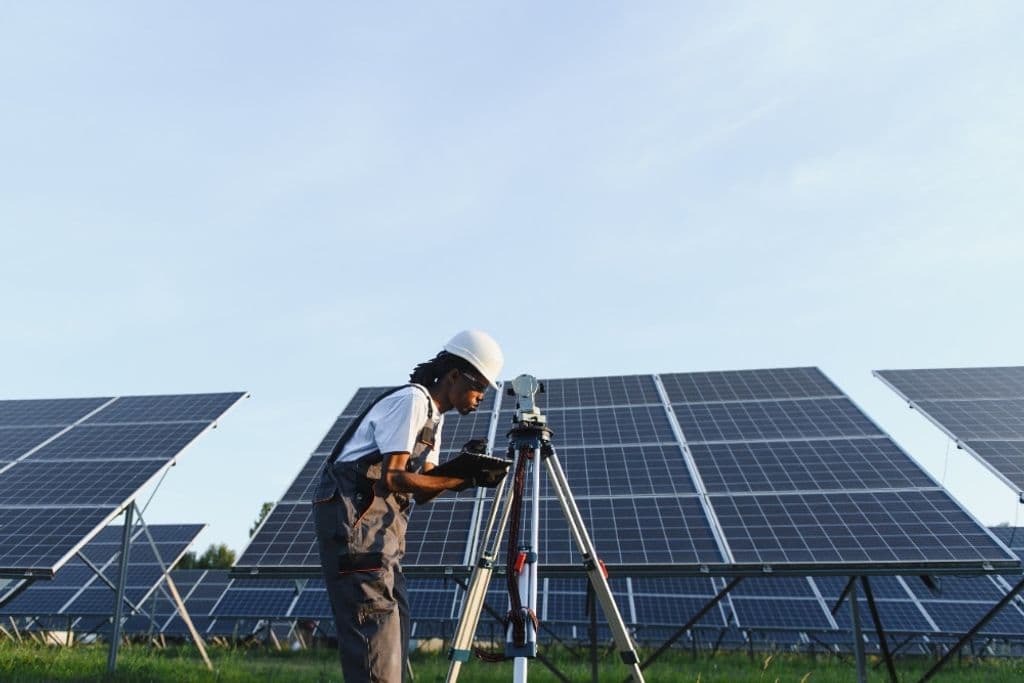
Solar power development is one of the largest energy programs ever planned in Indonesia, with a target of reaching 100 GW of capacity within three years.
If successfully realized, the program would not only accelerate the clean energy transition, but also expand electricity access, promote regional economic growth, and unlock large-scale green investment opportunities.
The Indonesian government is currently preparing various strategies to achieve this target.
In addition to expanding the use of solar energy, the government is adjusting the national electricity plan, strengthening the power grid, and encouraging collaboration with the private sector to support this ambitious program.
Related Article: New and Renewable Energy: Lessons from Countries That Have Successfully Transitioned
The 100 GW Solar Power Program Marks a Major Step in Indonesia’s Energy Transition
President Prabowo Subianto has set a target to develop solar power plants with a total capacity of 100 GW within three years.
The program would become one of the largest renewable energy initiatives in Indonesia’s history and an important step toward strengthening national energy security.
The plan consists of two main schemes:
- Approximately 80 GW of village-scale solar power plants equipped with Battery Energy Storage Systems, or BESS, and managed through Koperasi Desa Merah Putih, or KDMP.
- Approximately 20 GW of solar power plants connected directly to the national electricity grid.
Eniya Listiani Dewi, Director General of New, Renewable Energy, and Energy Conservation at the Ministry of Energy and Mineral Resources, explained that the government is adjusting the national electricity plan to accommodate the additional solar power capacity.
One of the main objectives of the solar power development program is to reduce dependence on diesel-fired power plants, particularly in eastern Indonesia, where electricity costs remain relatively high.
The program also supports the government’s target of achieving 100% electrification by 2029.
During the initial stage, the government plans to prioritize the development of approximately 13 GW, particularly in regions that already have adequate electricity distribution infrastructure.
In addition, Rosan Roeslani, Minister of Investment and Downstream Industry and Head of BPI Danantara, stated that Danantara had developed a 1 MW pilot solar power project in Sumenep Regency.
The prototype will be evaluated together with the Ministry of Energy and Mineral Resources and the Ministry of Higher Education before being implemented more widely in other regions.
Major Challenges in Achieving the Solar Power Development Target
Despite its significant potential, developing 100 GW of solar power capacity within three years will not be easy.
Indonesia’s current installed solar power capacity remains at around 1 GW. This means the country would need to add approximately 33 GW every year, or nearly 3 GW every month, for three consecutive years.
By comparison, many developing countries in Asia are generally able to add only around 5–10 GW of solar power capacity each year.
According to Dr. Dessy Rachmawatie, M.Si., an energy economics expert from the Faculty of Economics and Business at Universitas Muhammadiyah Yogyakarta, the target represents an unprecedented leap in Indonesia’s energy development history.
She identified three major challenges that need to be addressed immediately:
- Limited electricity grid infrastructure.
- Complex land regulations and permitting procedures.
- A business model capable of attracting investors while protecting national interests.
The government therefore needs to reform regulations, accelerate permitting processes, expand innovative financing schemes such as blended finance, and create greater investment opportunities for the private sector and international partners.
The government estimates that the program will require more than US$100 billion in investment, equivalent to approximately Rp1.767 quadrillion.
Around 70% of the funding is expected to come from Independent Power Producers, or IPPs, making collaboration with the private sector a critical factor.
Learning from China’s Success in Developing Solar Energy
According to Dessy, Indonesia can draw lessons from China’s success in building its solar energy industry.
China did not immediately develop large-scale generating capacity. Instead, the country first strengthened its domestic industry through technological innovation, financing, and supply chain development.
This strategy eventually enabled China to become one of the world’s leading solar panel producers within approximately 25 years.
Indonesia is currently considered to be in the early adoption stage, giving the country an opportunity to build a stronger foundation for its renewable energy industry.
Several positive developments have already emerged, including:
- The development of floating solar power plants.
- Increased adoption of rooftop solar systems in the industrial sector.
- The development of wind power projects in Sulawesi.
If this momentum is managed effectively, solar power development will not only produce clean electricity, but also stimulate rural economic growth, create green jobs, reduce development gaps between regions, and strengthen national energy security.
Related Article: Wind Energy: How It Works, Examples of Its Use, and Its Challenges
Solar Power and Renewable Energy Development Continue to Advance with TBS Energi Utama
Indonesia’s national solar power target will become more achievable with support from companies that consistently develop renewable energy projects across the country.
One such company is TBS Energi Utama, which has continued to expand its clean energy portfolio through various strategic projects in recent years.
In the hydropower sector, TBS Energi Utama acquired PT Adimitra Energi Hidro, or AEH, in 2020 through its subsidiary PT Toba Bara Energi Tbk, or TBAE.
The 2 × 3 MW mini-hydropower project in Lampung officially reached its Commercial Operation Date on January 22, 2025, and now supplies 6 MW of clean electricity to the Southern Sumatra power system.
Also in 2020, TBS Energi Utama acquired PT Bayu Alam Sejahtra, or BAS, to develop wind power potential in East Nusa Tenggara as part of its renewable energy diversification strategy.
In the solar energy sector, TBS Energi Utama developing the 46 MWp Tembesi Floating Solar Power Plant in Batam.
The project achieved Financial Closing in 2024 and is targeted to begin commercial operations in 2026 while also connecting to the national electricity grid.
The floating solar power plant is expected to provide various benefits, including reducing carbon emissions, improving air quality, creating green jobs, encouraging technology transfer, and strengthening collaboration with surrounding communities.
These achievements demonstrate that renewable energy development is no longer merely an aspiration, but is being realized through concrete projects.
With experience in developing a 6 MW mini-hydropower plant in Lampung, a 46 MWp floating solar power project in Batam, and wind energy exploration in East Nusa Tenggara, TBS Energi Utama continues to demonstrate its commitment to supporting Indonesia’s energy transition.
Going forward, collaboration among the government, industry players, and companies such as TBS Energi Utama will be essential to accelerating solar power development and creating a cleaner, more resilient, and sustainable national energy system.