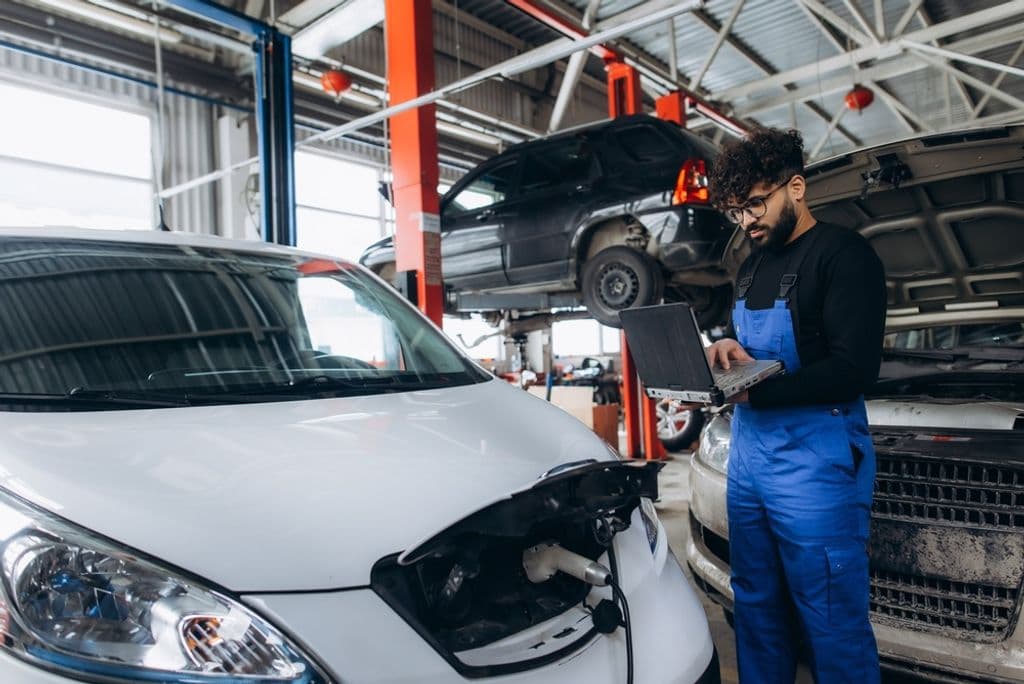
Regular electric car maintenance is important to keep vehicle performance optimal, extend battery life, and ensure a comfortable driving experience.
From maintaining the battery, braking system, and tires to performing software updates, each maintenance step can help extend the vehicle’s lifespan.
Although electric cars have fewer moving components than gasoline-powered vehicles, that does not mean they are maintenance-free.
Owners still need to understand several key components, especially the battery and electrical systems. So, what maintenance should be performed?
Related Article: Electric Vehicles Are Today’s Environmentally Friendly Transportation: Discover Their Advantages
Essential Electric Car Maintenance
To keep an electric vehicle performing at its best, here are several maintenance steps that should be carried out regularly.
1. Maintain Battery Health
The battery is one of the most important components in an electric car. Its condition directly affects driving range, performance, and vehicle lifespan.
To maintain battery health, avoid regularly letting the charge drop all the way to 0% or continuously charging it to 100% for everyday use. Keeping the battery within a range of around 20–80% can be a good charging habit for routine use.
However, charging to 100% is still acceptable when maximum driving range is needed, such as before a long trip.
Use a charger recommended by the manufacturer to ensure the charging process follows the vehicle’s specifications.
Fast charging should also be used when necessary. For routine home charging, use the charging method recommended by the manufacturer.
While fast charging is very useful when power is needed quickly, especially during long-distance travel, frequent use can place greater thermal stress on the battery.
2. Pay Attention to Battery Temperature
Extreme temperatures, whether too hot or too cold, can affect battery performance and durability.
This is particularly relevant for electric vehicle users in Asia, including Indonesia, where temperatures remain relatively high throughout the year.
The thermal management system in an electric car helps keep the battery within an appropriate temperature range.
Even so, owners can still help by avoiding parking the vehicle under direct sunlight for extended periods.
Whenever possible, park in a shaded or protected area. This simple habit can help maintain battery condition and improve cabin comfort.
3. Check the Cooling System
In addition to the battery, the cooling system also requires attention.
This system helps maintain the temperature of the battery and certain vehicle components within an optimal range.
Check the coolant level according to the manufacturer’s maintenance schedule and make sure there are no leaks.
If a temperature warning appears or there is an issue with the cooling system, have the vehicle inspected at an authorized service center as soon as possible.
4. Do Not Ignore the Braking System
Electric cars generally use regenerative braking.
This technology converts part of the kinetic energy generated when the vehicle slows down into electrical energy that can be returned to the battery.
This feature can reduce the use of mechanical brakes, but it does not mean the brake pads and brake fluid no longer need to be checked.
Regular inspections remain important, especially if the vehicle is frequently used on downhill roads, in dense urban areas, or in traffic conditions that require repeated braking.
5. Maintain the Tires and Suspension
Electric cars are generally relatively heavy because of their high-capacity batteries.
This means the tires require particular attention.
Check tire pressure regularly and adjust it according to the manufacturer’s recommendations. Proper tire pressure helps maintain stability, comfort, and energy efficiency.
In addition, rotate the tires according to schedule and inspect the suspension regularly.
A well-maintained suspension helps ensure a comfortable driving experience, especially on roads with varying conditions, which are common in many Asian cities.
6. Keep Software Up to Date
Modern electric cars use various software systems to manage the battery, power management, safety features, and entertainment functions.
For this reason, do not ignore software update notifications from the manufacturer.
Updates may include bug fixes, efficiency improvements, or new features.
Make sure updates are installed according to the provided instructions so that the vehicle’s systems continue to function properly.
7. Keep the Charging Area Safe
If you charge the vehicle at home, make sure the charging area is clean, dry, and supported by a suitable electrical installation.
Charging cables should be stored neatly and kept away from water and excessive heat sources.
The charging port should also be checked to ensure there is no dust or debris that could interfere with the electrical connection.
8. Clean the AC and Cabin Filters
Cabin comfort is one of the advantages of electric cars.
To maintain that comfort, clean the cabin and replace the AC filter according to schedule.
A clean filter helps maintain air quality while also supporting the performance of the cabin cooling system.
In tropical countries such as Indonesia, regular AC checks are also important because cooling systems are used frequently in daily driving.
Avoid Habits That Can Damage the Vehicle
In addition to regular maintenance, owners should also avoid several habits that can accelerate wear.
1. Driving with Aggressive Acceleration
Instant torque allows electric cars to accelerate quickly.
However, repeated aggressive acceleration can increase energy consumption.
Driving smoothly at a stable speed can help improve efficiency.
2. Ignoring Regular Maintenance
Electric cars may have fewer moving parts, but inspections are still necessary.
Electrical systems, sensors, fluids, batteries, and other components should be checked according to the recommended maintenance schedule.
3. Using an Incompatible Charger
Do not use just any charger simply because it is physically compatible.
Make sure the charging device meets the vehicle’s specifications and the manufacturer’s recommendations.
4. Not Making Use of Regenerative Braking
Learn how the regenerative braking system in your vehicle works.
Using it properly can help return energy to the battery while reducing the use of mechanical brakes.
Related Article: Understanding How Electric Cars Work Based on Their Types
TBS and the Development of Indonesia’s Electric Vehicle Ecosystem
The growth of electric vehicles is not only about the vehicles themselves, but also requires a supporting ecosystem.
TBS and GoTo Group established PT Energi Kreasi Bersama, or Electrum, in 2021 to build an integrated electric mobility ecosystem in Indonesia.
Electrum covers various parts of the electric vehicle value chain, including vehicle assembly, battery technology, battery swapping infrastructure, charging stations, and financing schemes.
In February 2022, President Joko Widodo inaugurated the launch of a collaborative electric vehicle ecosystem involving Electrum, Pertamina, Gogoro, and Gesits.
In the same year, Electrum also participated in the G20 Summit and B20 Forum in Bali by providing 50 electric motorcycles, 11 shelters, and 150 Gojek driver partners to serve delegates.
Financial support has also continued to grow.
In December 2024, Electrum secured US$15 million in financing from the Asian Development Bank, the Australian Climate Finance Partnership, and Bank DBS Indonesia.
The funding was used to accelerate vehicle procurement and expand the battery swapping network, with projected greenhouse gas emissions reductions of up to 123,000 tons per year.
In October 2024, Electrum launched the H3i electric motorcycle at IMOS, offering both home charging and access to the battery swapping network.
Then, in 2025, Electrum introduced the H1 to provide consumers with another electric vehicle option.
By 2025, more than 6,000 electric vehicles were operating on the road, supported by more than 320 battery-swapping station locations.
This infrastructure serves more than 19,000 battery swaps every day and has contributed to avoiding more than 3,200 tons of CO2 emissions.
Electric car maintenance can actually be carried out through simple habits, such as maintaining a suitable battery charging range, checking tires and brakes, managing vehicle temperature, performing software updates, and following the recommended service schedule.
At the same time, the growth of the electric vehicle ecosystem requires support from multiple stakeholders.
Through Electrum, TBS continues to contribute to building a more integrated electric mobility ecosystem in Indonesia, covering vehicles, batteries, battery swapping, and supporting infrastructure.
With proper maintenance and an increasingly developed ecosystem, electric vehicles in Indonesia can become an increasingly practical, efficient, and sustainable mobility option.