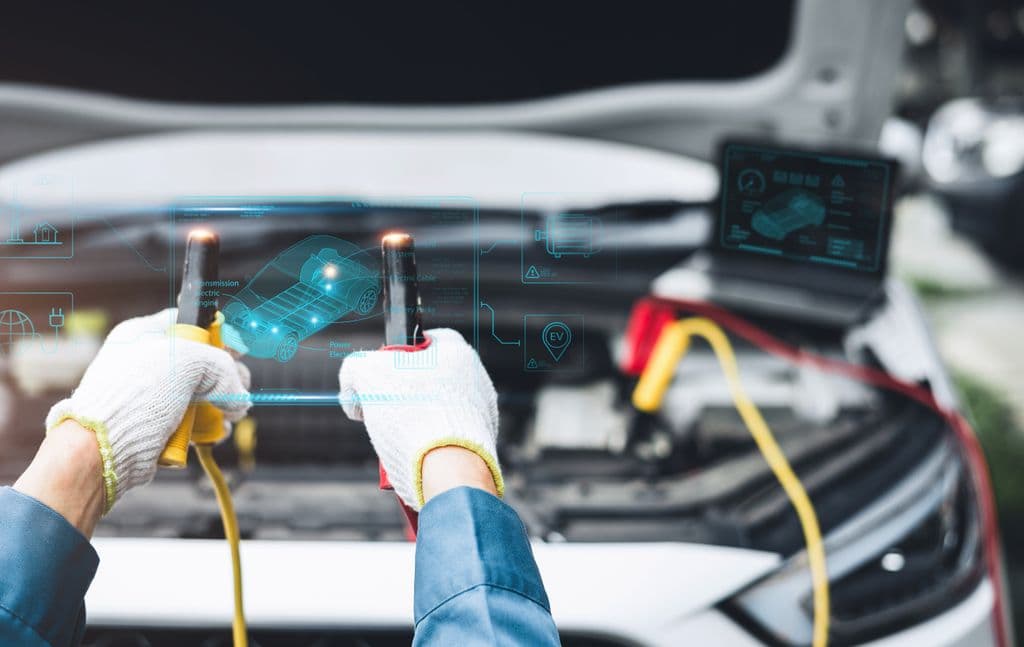
A Battery Management System (BMS) is an important technology that helps keep electric vehicle (EV) batteries safe, efficient, and longer-lasting.
The system works by monitoring battery conditions, managing temperature, balancing cells, and protecting the battery from potentially dangerous conditions such as overcharging, overdischarging, and overheating.
As EV adoption continues to grow across Asia, including Indonesia, the need for reliable BMS technology is becoming increasingly important.
Beyond supporting vehicle performance, BMS technology also plays a key role in building a safe and reliable electric vehicle ecosystem, from electric cars and motorcycles to battery swapping infrastructure.
What Is a Battery Management System?
A Battery Management System, or BMS, is an electronic system designed to control, monitor, and protect rechargeable batteries.
In electric vehicles, the BMS acts as the “brain” of the battery because it continuously collects data and makes decisions based on the battery’s condition.
Some of the main parameters monitored include State of Charge (SOC), which indicates the remaining battery level, and State of Health (SOH), which reflects the overall condition of the battery. In addition, the BMS monitors voltage, current, and the temperature of different parts of the battery.
Through this monitoring process, the BMS helps ensure that the battery operates within safe limits. If a condition occurs that could potentially damage the battery, the system can issue a warning or automatically activate protective measures.
Read Also: Electric Cars During Floods: A Safety Guide for the Rainy Season
Main Components of a Battery Management System
To operate effectively, a Battery Management System consists of several interconnected components.
1. Monitoring Sensors
Sensors monitor battery voltage, current, and temperature in real time. This data provides the foundation for the BMS to assess the battery’s condition.
2. Controller and Microprocessor
These components process data collected by the sensors to estimate battery conditions, including SOC and SOH, while determining what actions need to be taken.
3. Balancing Circuit
The balancing circuit helps ensure that the charge levels of individual battery cells remain balanced.
This is important because a single battery pack contains many cells that may have slightly different characteristics.
4. Protection Circuit
The protection circuit helps prevent damage caused by overcurrent, overvoltage, undervoltage, overheating, and other potentially hazardous conditions.
5. Communication Interface
A BMS can communicate with the vehicle system and external devices through protocols such as CAN, UART, and RS485.
This communication allows battery condition data to be used by other vehicle systems.
How Does a Battery Management System Work?
In simple terms, a BMS works by monitoring, analyzing, and then taking action based on the condition of the battery.
This process takes place continuously while the battery is being used or charged.
1. Monitoring Battery Conditions
The BMS measures voltage, current, temperature, SOC, and SOH.
This information helps the system determine how much energy remains in the battery and how well the battery is performing.
2. Protecting the Battery
The BMS prevents the battery from operating outside safe limits.
For example, overvoltage protection helps prevent excessive charging, while undervoltage protection helps prevent the battery from being discharged too deeply.
The system also provides protection against excessive current and temperatures that are either too high or too low.
As a result, the risk of battery damage and safety issues can be reduced.
3. Balancing Battery Cells
Each battery pack consists of many cells.
If the charge levels between cells become unbalanced, the capacity and overall performance of the battery pack can decline.
A BMS can perform active balancing by transferring energy from cells with a higher charge level to cells with a lower charge level.
In passive balancing, excess energy is released as heat through resistors.
Both approaches are designed to help maintain cell balance and extend battery life.
4. Managing Temperature
Temperature has a significant impact on battery performance and safety.
For this reason, the BMS can work together with cooling or heating systems to keep the battery within an appropriate temperature range.
Temperature management is also important for reducing the risk of thermal runaway, a condition in which rising temperature triggers further increases in heat and can cause serious battery damage.
The Role of BMS in EV Development Across Asia and Indonesia
The growth of electric vehicles across Asia is making Battery Management System technology increasingly strategic.
BMS development is no longer focused only on vehicles, but also on charging technologies, battery swapping, battery health analysis, and battery management after the end of its useful life.
In Indonesia, this need is becoming increasingly relevant as the government continues to encourage the development of the electric vehicle ecosystem and greater value creation within the domestic battery industry.
BMS development also needs to consider local operating conditions, including Indonesia’s relatively high ambient temperatures.
In addition to four-wheeled vehicles, electric motorcycles are becoming an important part of Indonesia’s EV development.
In battery swapping systems, the BMS plays an important role because battery conditions need to be assessed and battery data must be communicated quickly whenever a battery is exchanged.
In the future, BMS technology is also expected to increasingly incorporate artificial intelligence (AI), data analytics, smart charging, and next-generation battery technologies.
These developments could help predict battery lifespan, detect potential problems earlier, and improve charging efficiency.
BMS technology still faces several challenges, including the accuracy of battery condition estimates, temperature management under extreme conditions, data security, charging efficiency, and battery lifespan prediction.
However, with continued innovation, EV batteries have the potential to become safer, more efficient, and easier to manage.
Read Also: Modern Transportation and Its Role in Building Sustainable Mobility
TBS and Indonesia’s Electric Vehicle Ecosystem
One of the companies contributing to the development of Indonesia’s electric vehicle ecosystem is TBS.
In 2021, TBS and GoTo established PT Energi Kreasi Bersama (Electrum) to develop an integrated electric mobility ecosystem.
Electrum covers various aspects of the ecosystem, including vehicle assembly, battery technology, battery swapping, charging stations, and electric vehicle financing.
This development forms part of efforts to strengthen Indonesia’s electric vehicle value chain.
In February 2022, President Joko Widodo inaugurated a collaborative electric vehicle ecosystem development initiative involving Electrum, Pertamina, Gogoro, and Gesits.
In the same year, Electrum also supported the G20 Summit and B20 Forum in Bali by providing 50 electric motorcycles, 11 shelters, and 150 Gojek driver partners.
Support for the ecosystem’s expansion continued in December 2024, when Electrum secured a US$15 million financing package from the Asian Development Bank (ADB), the Australian Climate Finance Partnership, and Bank DBS Indonesia.
The financing was used for vehicle procurement and the expansion of the battery swapping network, with the initiative projected to reduce greenhouse gas emissions by 123,000 tonnes per year.
On the product side, Electrum launched the H3i electric motorcycle at IMOS in October 2024, offering both home charging and access to its battery swapping network.
A year later, Electrum introduced the H1 as another electric vehicle option.
By 2025, the Electrum ecosystem had recorded more than 15,000 electric vehicles in operation, supported by over 500 battery swapping locations across Jakarta.
The expansion of this infrastructure has enabled more than 19,000 battery swaps per day and helped avoid more than 3,200 tonnes of CO₂ emissions.
Ultimately, a Battery Management System is more than just an electronic component inside an electric vehicle.
It is an important part of the transition toward safer, more efficient, and more sustainable mobility.
Through the development of its electric vehicle ecosystem, including vehicles, batteries, and battery swapping infrastructure, TBS continues to contribute to Indonesia’s transformation toward more sustainable energy and mobility.